
Optomap Retinal Imaging
OPTIQUE OF SOUTHWELL
Advanced retinal technology in our Southwell Practice.
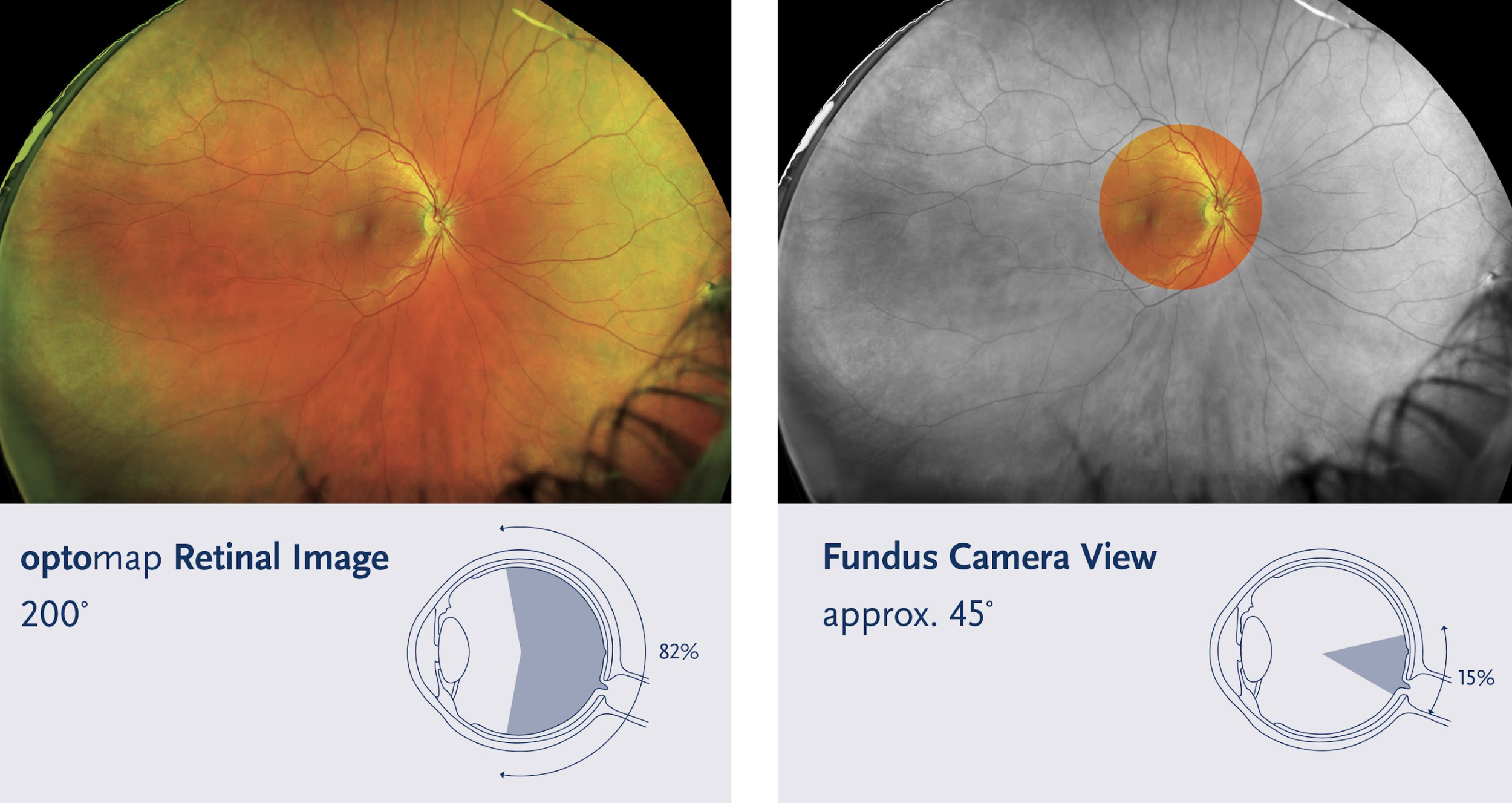
Optomap ultra-widefield retinal imaging captures 80% of your retina in a single scan — no dilation drops, no discomfort, in under a second.
200°: The field of view captured in just one scan (Traditional methods typically capture only 30–45°).
0.4s: The time it takes to capture a complete retinal image. It is quick, comfortable, and requires no eye drops.
What is Optomap Retinal Imaging?
Optomap Retinal Imaging
Your retina is the only place in your body where blood vessels can be viewed directly without surgery. That makes it a uniquely powerful window into your overall health — not just your eyesight.
Optomap is an ultra-widefield retinal imaging system that captures a panoramic photograph of your retina in a single scan. Unlike traditional methods that require eye drops to widen the pupil and only show a small section at a time, Optomap gives your optometrist a comprehensive view almost instantly.
At Optique of Southwell, we use Optomap as part of our comprehensive eye examinations to help detect, monitor, and manage eye and general health conditions earlier than ever before.
How Optomap Works at Optique of Southwell
The whole process takes just a few minutes and fits neatly into your routine eye examination.
You look into the device: Like looking through a keyhole — one eye at a time. There is no contact with your eye and no discomfort.
A single flash captures everything: Low-powered laser wavelengths scan your retina in under half a second, producing a high-resolution panoramic image.
Your optometrist reviews the image: We discuss the results with you straight away, showing you the image on screen so you can see exactly what we see.
Your image is saved for comparison: Your Optomap is stored securely in your records so future exams can track any changes over time.
-
Traditional retinal examination, even with dilation drops, reveals only a small portion of the retina. Optomap changes that entirely by offering several distinct benefits:
See more of your retina: Optomap captures up to 200 degrees of the retinal surface — roughly 80% — in a single image. Conditions lurking at the edges are no longer hidden.
Earlier detection, better outcomes: Many serious eye conditions develop silently. Optomap helps your optometrist spot the earliest signs before you notice any symptoms or vision loss.
Comfortable — no drops needed: Dilation drops cause blurred vision and light sensitivity for hours. Optomap doesn't require them, so you can drive home and carry on with your day.
Track changes year on year: Because images are stored digitally, your optometrist can compare scans from every visit — making it far easier to spot subtle changes before they become problems.
Understand your own eye health: Seeing a clear, detailed image of your own retina makes it far easier to understand your optometrist's findings and feel involved in your care.
A window into wider health: Retinal blood vessels can reveal early signs of systemic conditions including high blood pressure, diabetes, and cardiovascular disease.
-
Optomap's wide field of view gives your optometrist a significantly better chance of identifying early signs of both eye-specific and systemic health conditions, including:
Glaucoma
Age-related macular degeneration (AMD)
Diabetic retinopathy
Retinal tears
Retinal detachment
Retinal vein occlusion
Hypertensive retinopathy
Choroidal naevi (eye freckles)
Cardiovascular disease indicators
Multiple sclerosis signs
Ocular melanoma
Peripheral retinal lesions
Did you know? Studies show that optometrists using Optomap imaging detect retinal pathology in 97% of patients who have no visual symptoms. Many of these findings would go unnoticed with a traditional examination — underscoring why this technology matters for preventative eye care.
-
No. Optomap is an important addition to your eye examination at Optique of Southwell, not a replacement. Your optometrist will still carry out all the usual checks for vision, eye pressure, and eye health — Optomap simply gives them a much richer, wider view of your retina to work with.
-
Yes. Optomap uses low-powered laser wavelengths that are completely safe for your eyes. The process is entirely non-invasive and takes less than a second per eye. It is suitable for adults and children alike.
-
In the vast majority of cases, Optomap imaging removes the need for dilation drops. Occasionally, your optometrist may still recommend dilation for a more detailed view of a specific area — they will always discuss this with you beforehand.
-
We recommend having an Optomap image taken at each routine eye examination — typically every one to two years for most adults. If you have diabetes, a family history of eye disease, or other risk factors, more frequent examinations may be advised.
-
Optomap is available as an optional addition to your eye examination at Optique of Southwell for just £30. We believe the peace of mind and depth of information it provides makes it well worth the small additional investment in your eye health.
-
Optomap is beneficial for almost everyone, but is particularly recommended if you have diabetes, high blood pressure, a family history of glaucoma or macular degeneration, are over 40, experience flashing lights or floaters, or simply want the most thorough retinal health check available.